
Your loans and their real weight on your net worth.
Loans and credit: track the outstanding balance and its real effect on your net worth.
What you can do
Add your loans
Mortgage, consumer credit, peer-to-peer loan.
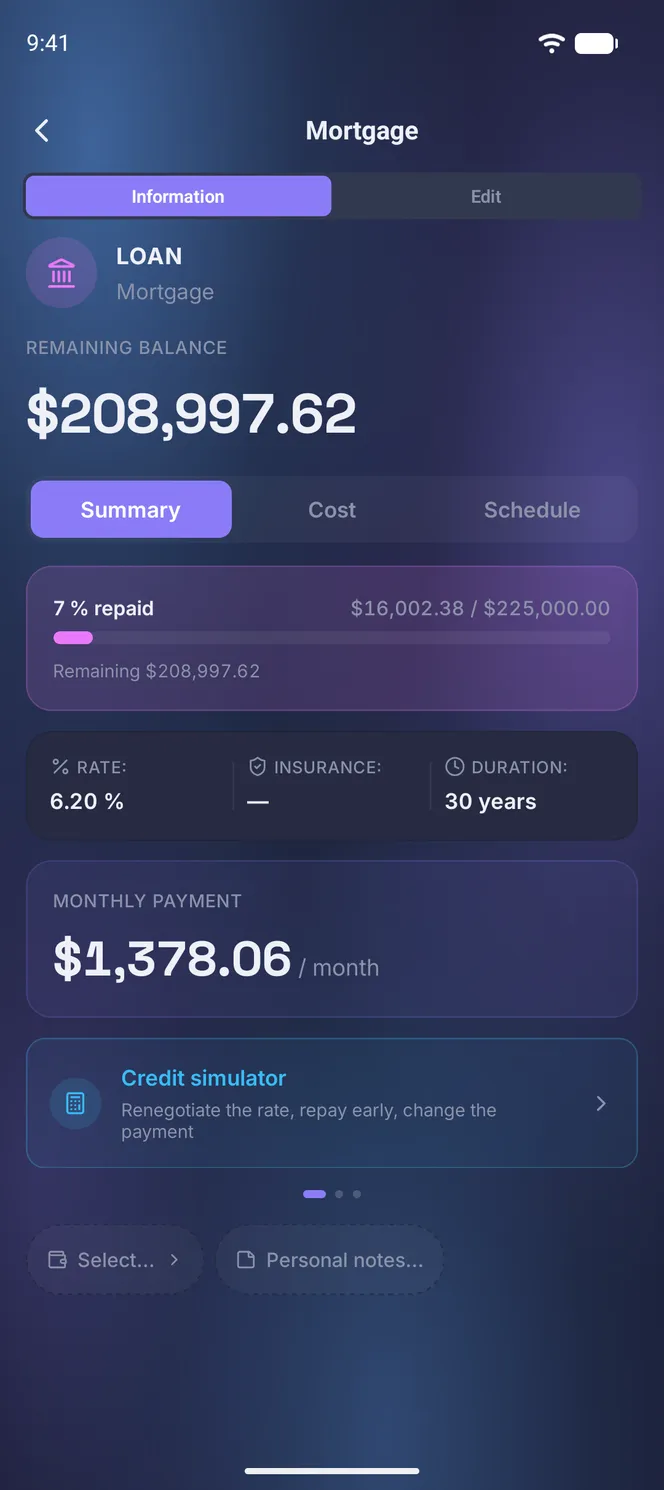
Outstanding balance
The balance updates as your monthly payments go through.
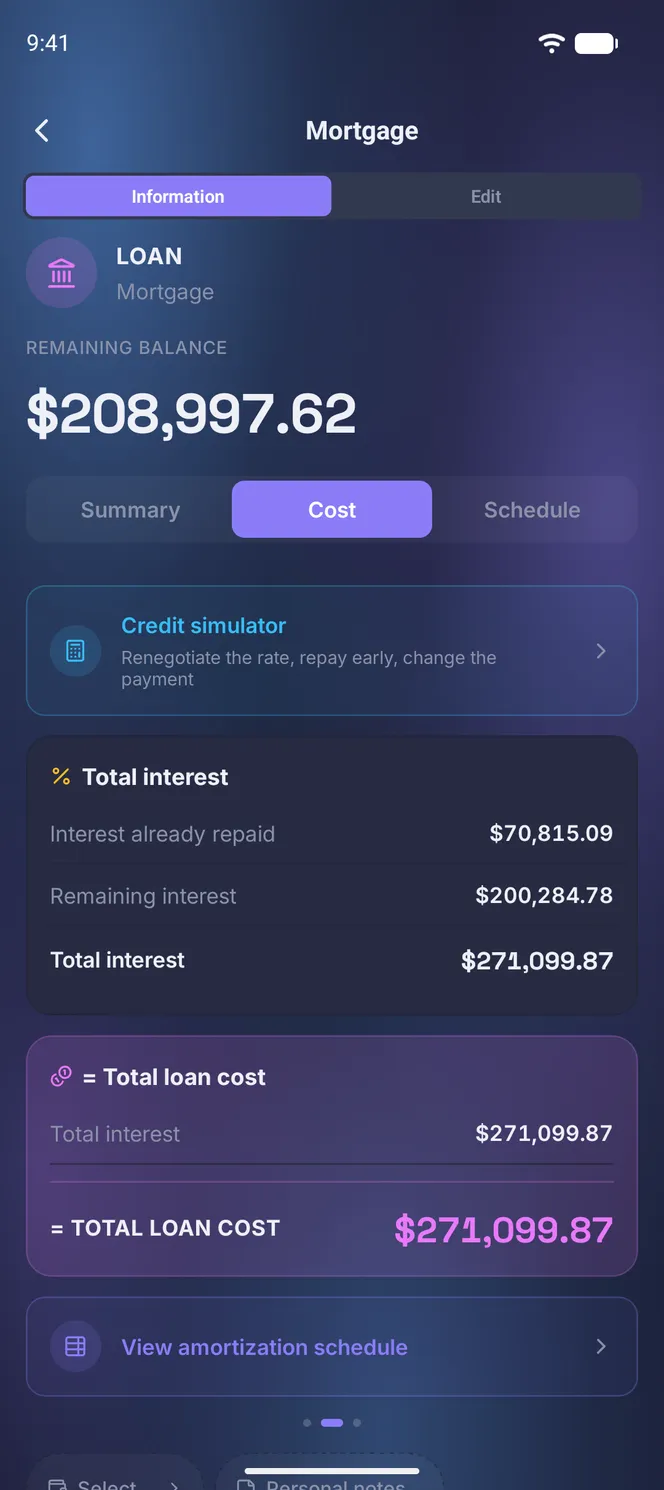
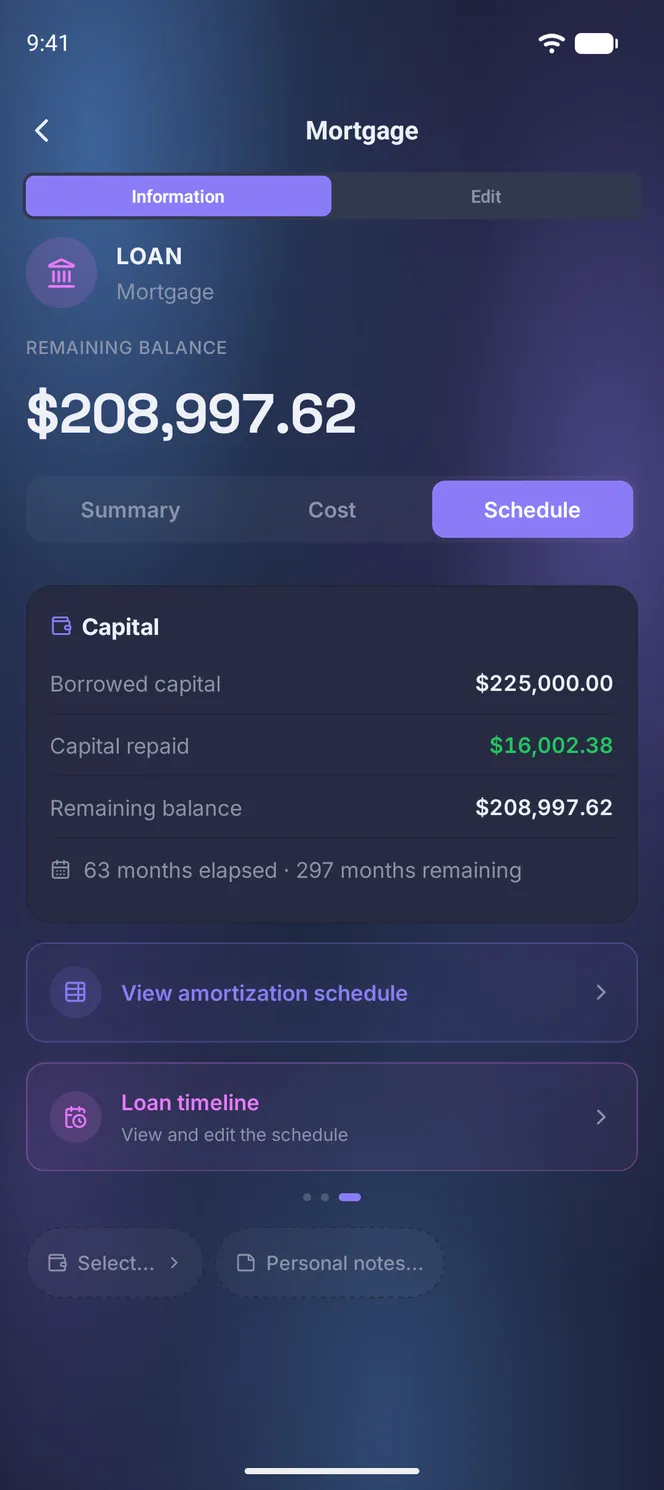
Amortization table
See the split between principal and interest, payment by payment.
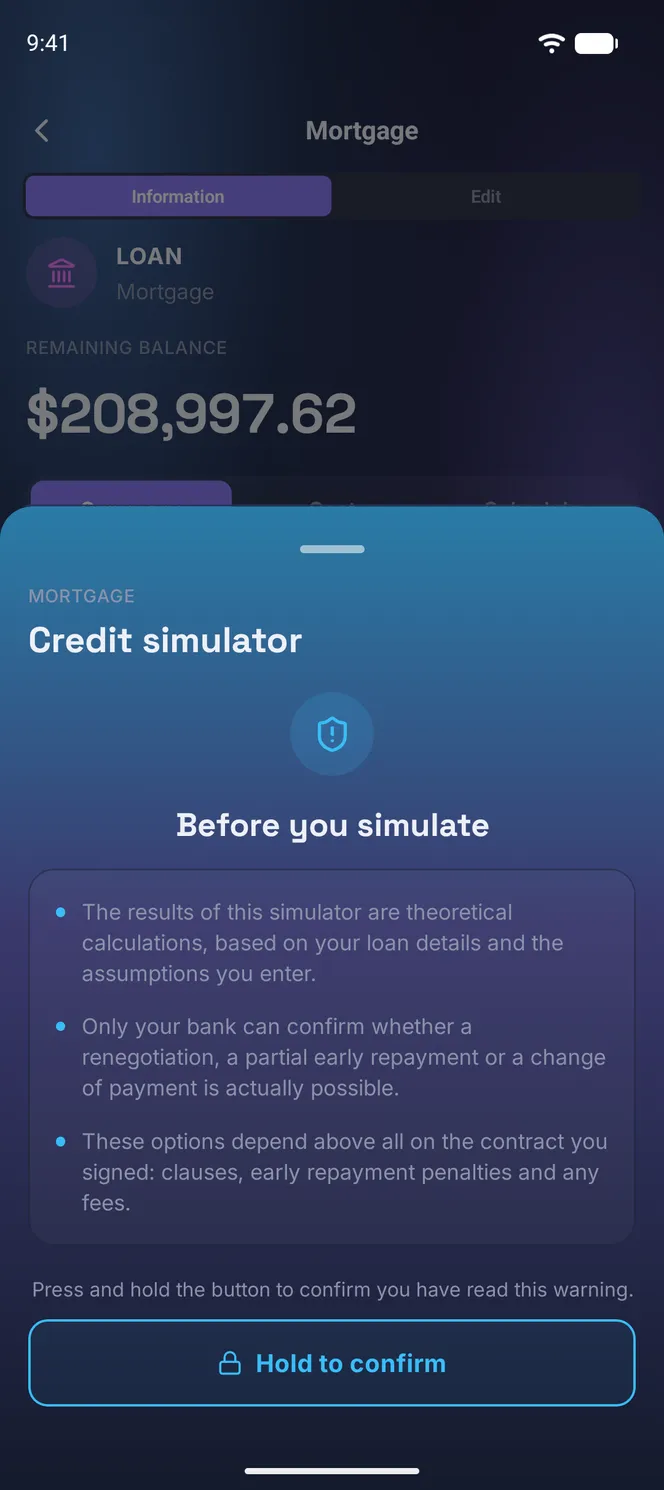
Loan simulator
Estimate the effect of paying off early or renegotiating.
Net worth
Your debts are deducted to give your genuinely net position.
Real-life schedules
Deferral, grace period, payment steps, variable rate, interest-only or balloon loan: declare the actual schedule of your contract.
Why track your debts as closely as your assets?
A net worth is not just what you own: it is measured net, assets minus debts. Ignoring or underestimating an ongoing loan inflates the picture, even though the outstanding balance does shrink every month, it remains a very real commitment until it is paid off.
How Finvygo handles your loans
Mortgage, consumer loan or peer-to-peer loan: each type of debt is declared with its own characteristics, amount borrowed, rate, term, monthly payment and, for a mortgage, the associated borrower's insurance. A property can be attached directly to the loan financing it.
The outstanding balance amortizes automatically at every payment, with no re-entry on your part, and the full amortization table stays available at any time, payment by payment, with the split between principal, interest and insurance, viewable by month or by year.
And because a real loan is rarely a perfect constant annuity, the schedule can be edited directly: deferrals and grace periods, payment steps, variable rates, insurance changes mid-loan, quarterly or yearly payments, interest-only or balloon loans. Country-specific loan templates let you declare these structures in a few fields, and the outstanding balance and total cost then reflect the contract you actually signed, not a theoretical approximation.
Simulating before you decide
Before deciding on an early repayment or a renegotiation, it is worth working out the real effect first: new monthly payment, total loan cost, savings on remaining interest. The built-in simulator lets you test these scenarios without leaving the app.
It also lets you compare up to four bank offers side by side, with a comparison table and an automatic verdict, useful before taking out a new loan or considering refinancing. These simulations remain estimates, to confirm with your lender.
Go further
Frequently asked questions
What types of loans can I track?
Mortgage, consumer credit, peer-to-peer loan, or any other debt. Each type is declared with its own characteristics: amount, rate, term, monthly payment, and insurance where relevant for a mortgage.
Does the outstanding balance update on its own?
Yes. It amortizes automatically at every payment, with no re-entry on your part, and is deducted directly from your net worth.
Can I see my amortization schedule?
Yes, payment by payment, with the split between principal, interest and insurance, viewable by month or by year.
How do I simulate an early repayment or a renegotiation?
A built-in simulator works out the effect of an early repayment or a renegotiation on your monthly payment and the total loan cost. A comparison tool also lets you put several offers side by side before deciding.
How do my debts affect my net worth?
The outstanding balance of each loan is deducted from the value of your assets to get your real net worth, recalculated automatically at every amortized payment.
My loan has a deferral, payment steps or a variable rate: is that supported?
Yes. The amortization table can be edited directly to match the contract: deferrals and grace periods, payment steps, rate or insurance changes mid-loan, quarterly or yearly payments, interest-only or balloon loans. Country-specific loan templates pre-fill the common structures.
Other solutions
Bring your whole net worth together
Find all your assets, physical and financial alike, in one place.
Create my account